


News and Information
The difference between reflow soldering and wave soldering in PCB manufacturing
2025-12-04
Soldering and wave soldering are two important soldering technologies in the field of electronic component manufacturing. Both methods are used to mount components onto printed circuit boards (PCBs); however, each method has different operating principles, applications, and advantages and disadvantages. A thorough understanding of... The difference between soldering and wave soldering will help engineers and manufacturers choose the welding method that best suits their needs and production lines.
The development history of soldering and wave soldering
The origin and emergence of each welding method
Wave soldering is a soldering method that emerged in the 1950s, at a time when demand for printed circuit board manufacturing was rapidly increasing. This method is designed to solder through-hole components by passing the entire PCB assembly through a wave of molten solder.
The reflow soldering method was developed in the late 1980s along with the growing popularity of surface-mount devices (SMD). This method uses a soldering oven to melt solder paste that has been pre-printed onto the PCB board.
Current development and application
Currently, wave soldering technology has undergone significant improvements, such as lead-free soldering to comply with RoHS standards, enabling more precise temperature control and facilitating easy integration with automated monitoring systems.
Fusion welding technology is also continuously evolving through the use of multi-zone heating furnaces to optimize the welding process, thereby minimizing porosity defects and enhancing weld reliability.
Today, both methods are still used depending on each factory's production requirements. The difference between soldering and wave soldering Careful analysis will help engineers select the most suitable welding technology for the manufacturing process.
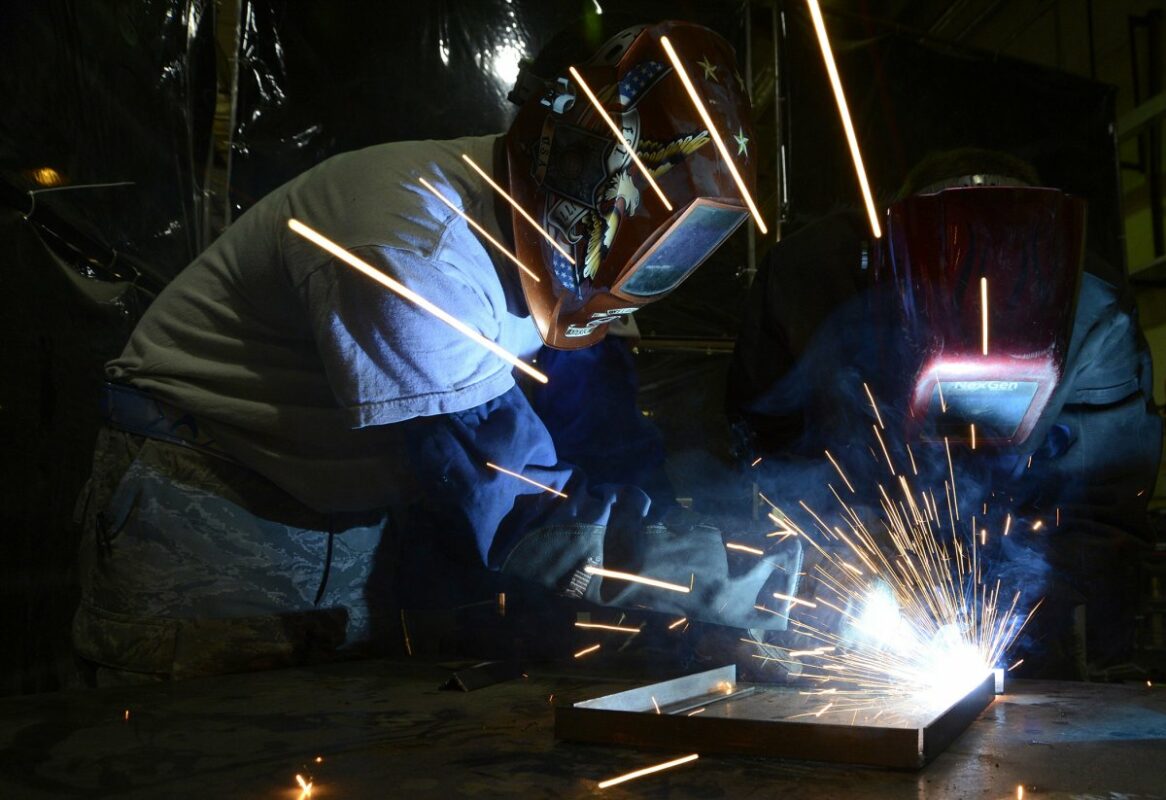
Compare the differences between soldering and wave soldering.
Wave soldering uses a different soldering method to manufacture PCB boards. This is the most optimal method for engineers when they need to solder multiple PCBs simultaneously.
The soldering process begins by applying flux to the components to be soldered. The flux plays a role in removing surface oxide layers and cleaning the metal before soldering. This step is considered crucial for ensuring a high-quality solder joint.
Next, similar to reflow soldering, a preheating process will be carried out to prevent thermal shock when components come into contact with high temperatures during the main soldering phase. Molten solder waves will flow across the PCB, creating solder joints between the components and the circuit board; these joints are formed during this stage. Once the soldering process is complete, the cooling system will help the PCB cool down, allowing the solder to solidify and firmly secure the solder joints.
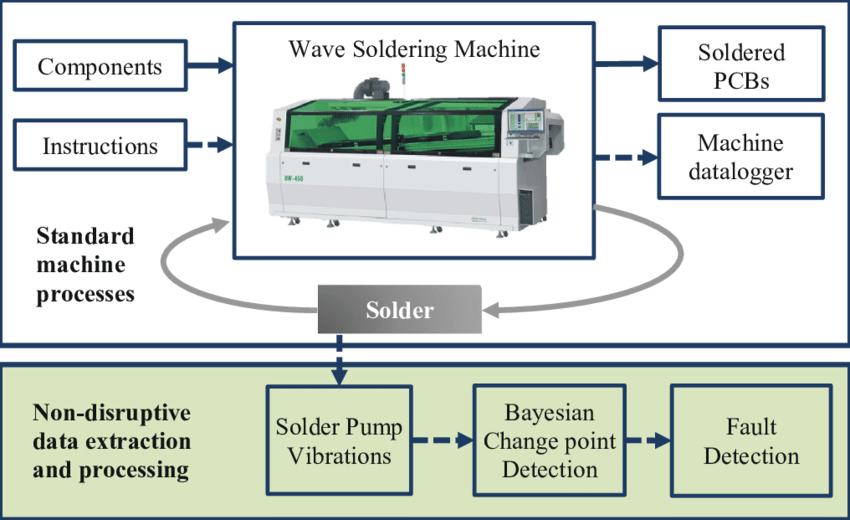
The internal environment of the soldering wave oven plays a crucial role in controlling soldering quality. If the temperature is not maintained accurately, it could lead to serious defects. In such cases, businesses may face numerous challenges if they fail to properly control the conditions during the soldering process. Controlling the temperature and environment during wave soldering is a key factor in ensuring the quality of PCB boards.
The soldering process consists of four critical stages to ensure a durable and reliable solder joint. The first stage is preheating, during which the circuit board and components are heated evenly to reach the required temperature. At the same time, this stage also helps remove volatile solvents from the solder paste, thereby preventing any adverse effects on solder quality.
The next stage is thermal soaking, during which the temperature continues to rise to activate the flux, helping to clean the surface of the pad and component leads, thereby facilitating an efficient soldering process. In the reflow soldering stage, the temperature reaches its peak, causing the solder paste to melt and bond the components to the circuit board. Temperature control during this stage is crucial. If the temperature is too low, the solder paste will not melt sufficiently to form a strong bond; conversely, if the temperature is too high, it could damage the components, especially BGA packages.
The cooling stage helps lower the temperature, allowing the solder paste to solidify and securely fix the components onto the PCB. This process ensures durable solder joints, minimizes the risk of defects, and guarantees product quality.
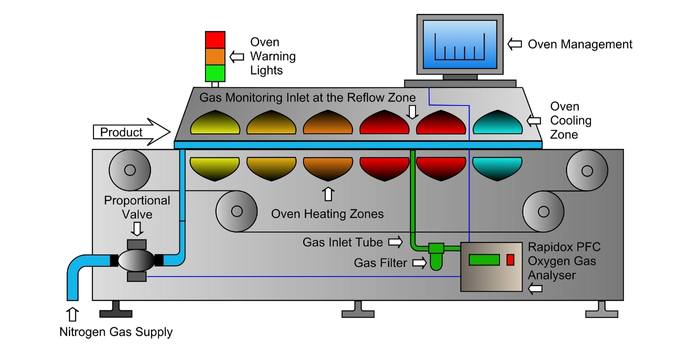
The difference between soldering and wave soldering lies in the core welding process. Understanding this key difference will help manufacturers optimize their production lines and minimize the rate of welding defects. Below is a detailed comparison table of the critical factors for each welding method:
| Criteria | Melting | Wave soldering |
| Operating principle | Use hot gas to melt the solder paste. | Use molten solder waves to solder components onto the PCB. |
| Complexity | Simple, easy to control. | It's more complex due to the unstable internal environment of the soldering oven. Even slight temperature fluctuations can cause PCB defects. |
| Speed & Cost | It takes more time and costs more, especially for large-scale production. | Supports mass PCB production, saving time and costs. |
| PCB design factors | Less dependent on pad size, pad shape, and component placement orientation. | It is necessary to carefully consider the pad size, pad shape, and component placement orientation to ensure solder joint quality. |
| Popular app | Most common in SMT PCB manufacturing. | Less common, but still widely used for through-hole components (THT). |
Weld quality according to each method
- In terms of mechanical strength, electrical conductivity, and long-term reliability, wave soldering produces strong solder joints and is particularly well-suited for components with long leads. However, the wave soldering method has the disadvantage of being prone to solder bridging defects.
- Reflow soldering yields higher joint strength for components mounted directly onto the PCB surface (SMD). The drawback is the risk of porosity occurring in the solder joints.
- Considering the impact on the PCB and components after soldering: Wave soldering can cause warping of the PCB due to high temperatures. Reflow soldering requires the PCB to have good thermal resistance to prevent cracking.
The applications of wave soldering and reflow soldering in manufacturing are illustrated specifically in the comparison table below:
| Criteria | Melted Steel | Wave Length |
|---|---|---|
| Component type | SMD | Through-Hole |
| Accuracy | Tall | Average |
| Investment cost | Tall | Average |
| Automaticity | Tall | Average |
| Production speed | Fast with SMD | Effective with THT |
Advantages and disadvantages of soldering and wave soldering
Advantages of fusion welding:
- High accuracy, suitable for small components
- The welding defect rate is lower due to the well-controlled heating process.
- Highly automated, suitable for mass production processes.
Disadvantages:
- High investment cost
- Requires modern machinery systems and strict temperature control.
Advantages of wave soldering:
- Wave soldering offers a fast production rate for printed circuit boards containing through-hole components.
- Lower investment costs compared to the fusion welding method.
Disadvantages:
- Welds are difficult to control, making it easy for defects such as lack of fusion or weld bridges to occur.
- Wave soldering is not suitable for small and densely packed SMD components.
The difference between soldering and wave soldering has been clearly analyzed across multiple factors—so when should you choose soldering, and when should you choose wave soldering?
Businesses can choose the fusion welding method to meet the following needs:
- Use SMD components
- High accuracy and few welding defects are required.
- The production line is modern and requires a high degree of automation.
- The wave soldering method is preferred in the following cases:
- For through-hole components
- Save on investment costs
- The PCB production line has a simple design and does not require high precision.
Currently, many manufacturers are adopting the trend of combining both wave soldering and reflow soldering methods to maximize the advantages of each technology.
- Soldering technology for SMD components
- Wave soldering technology for through-hole components
- Hybrid welding technology is used for more precise welding in each specific area.
Conclusion
The above article has provided a detailed analysis. The difference between soldering and wave soldering and the specific applications of these two methods. The choice of which soldering technology to use will depend on the type of components, costs, and the production processes of each factory. A clear understanding of the differences between these two soldering methods will enable businesses to gain the most comprehensive overview, thereby optimizing SMT production lines and enhancing product quality.
Previous:
Contact Us
Contact Number:
+86 21 6088 8500
+86 4006 777 950
+86 150 2686 5822
Email:
marketing@hapoin.com
Headquarter Address:
6, South Metropolis Garden, No. 1165, Jindu Road, Minhang District, Shanghai
OUTLETS
Service Outlets

Shanghai-Head Office
Shanghai Hapoin Enterprise Development Co., Ltd.
Address: Building 6, Southern Metropolis Garden, No. 1165, Jindu Road, Minhang District, Shanghai
Telephone:+86 150 2686 5822
Email:info@hapoin.com
Shenzhen Branch
Shenzhen Hapoin Ruihe Technology Development Co., Ltd.
Address: Room 302, 3rd Floor, Building B, Kaicheng High-tech Park, Dalang Street, Longhua District, Shenzhen
Telephone:+86 0755 2223 2285
Email:sales@hapoin.com
Hong Kong Branch
HAPOIN ENTERPISE LIMITED
Address: Unit 917A, 9/F., Tower A, New Mandarin Plaza, No. 14 Science Museum Road
Telephone:+00852 61187991
Email:sales@hapoin.com
Vietnam Branch
HAPOIN VIETNAM
Address: 6th Floor, CTM Office Building, No. 139, Zhipiao Road, Zhipiao District, Hanoi, Vietnam
Telephone:+84 398 848 969
Email:sales@hapoin.com
Japan Branch
HAPOIN CO., LTD.
Address: 6th Floor, 2-3-8 Iwamotocho, Chiyoda-ku, Tokyo
Telephone:+81 070 9356 1267
Email:sales@hapoin.com
Kunshan Office
Kunshan Office
Address: 10th Floor, Building B, Modern Plaza, No. 8, Weiye Road, Yushan Town, Kunshan City
Telephone:+86 150 2686 5822
Email:sales@hapoin.com
Taipei Branch
Uniwin Chemical Co.,LTD.
Address: No. 14, Alley 3, Lane 250, Section 2, Huanhe South Road, Taipei 10853
Telephone:+886 02 2336 2202
Email:sales@hapoin.com
Beijing Office
Beijing Office
Address: Room 306, Building 4, Zhongtou Oriental, West Zhihe North, Chaoyang District, Beijing
Telephone:+86 150 2686 5822
Email:sales@hapoin.com






Contact Number
Headquarter Address
6, South Metropolis Garden, No. 1165, Jindu Road, Minhang District, Shanghai
Follow the official account
Follow the video account

